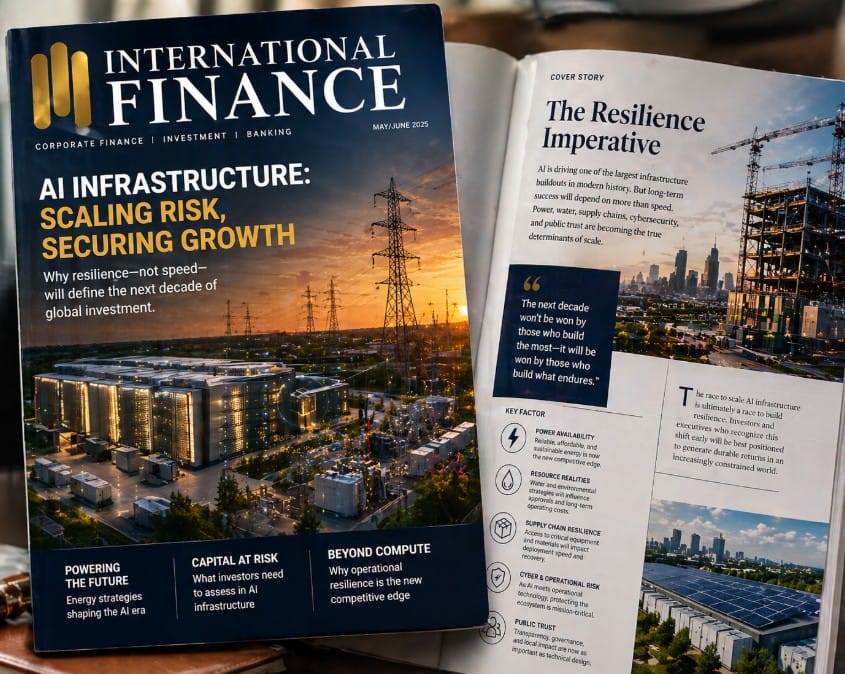
For readers of International Finance, the discussion around AI infrastructure is as a capital allocation, risk, and global competitiveness story. As a publication focused on connecting decision-makers, investors, and business leaders across emerging and developed markets, the magazine sits at the intersection where infrastructure scale meets financial consequence.
This article frames AI infrastructure not simply as a race for compute, but as a test of resilience across energy systems, supply chains, and governance. Over the next decade, the ability to scale AI will increasingly depend on access to reliable power, critical materials, and stable operating environments. The International Energy Agency projects that data center electricity demand will nearly double by 2030, underscoring how infrastructure constraints, not innovation limits, are beginning to shape growth. In this context, AI becomes less about technological capability alone and more about who can sustain it at scale.
For the financial audience of International Finance, this shift has direct implications. Infrastructure resilience is emerging as a determinant of valuation, investment risk, and long-term returns. Projects that cannot secure power, manage supply chain dependencies, or navigate regulatory and community pressures will face delays, cost overruns, or stranded capital. Conversely, organizations that align resilience with deployment strategy will gain a structural advantage, positioning themselves to scale more predictably in constrained environments.
Ultimately, the article positions resilience as a market signal. It is no longer a back-end operational concern, it is becoming a forward-looking indicator of which companies, regions, and investment strategies are best equipped to lead in the AI economy. For global investors and executives, that shift changes the conversation from “How fast can we build?” to “How sustainably, and securely, can we scale?”