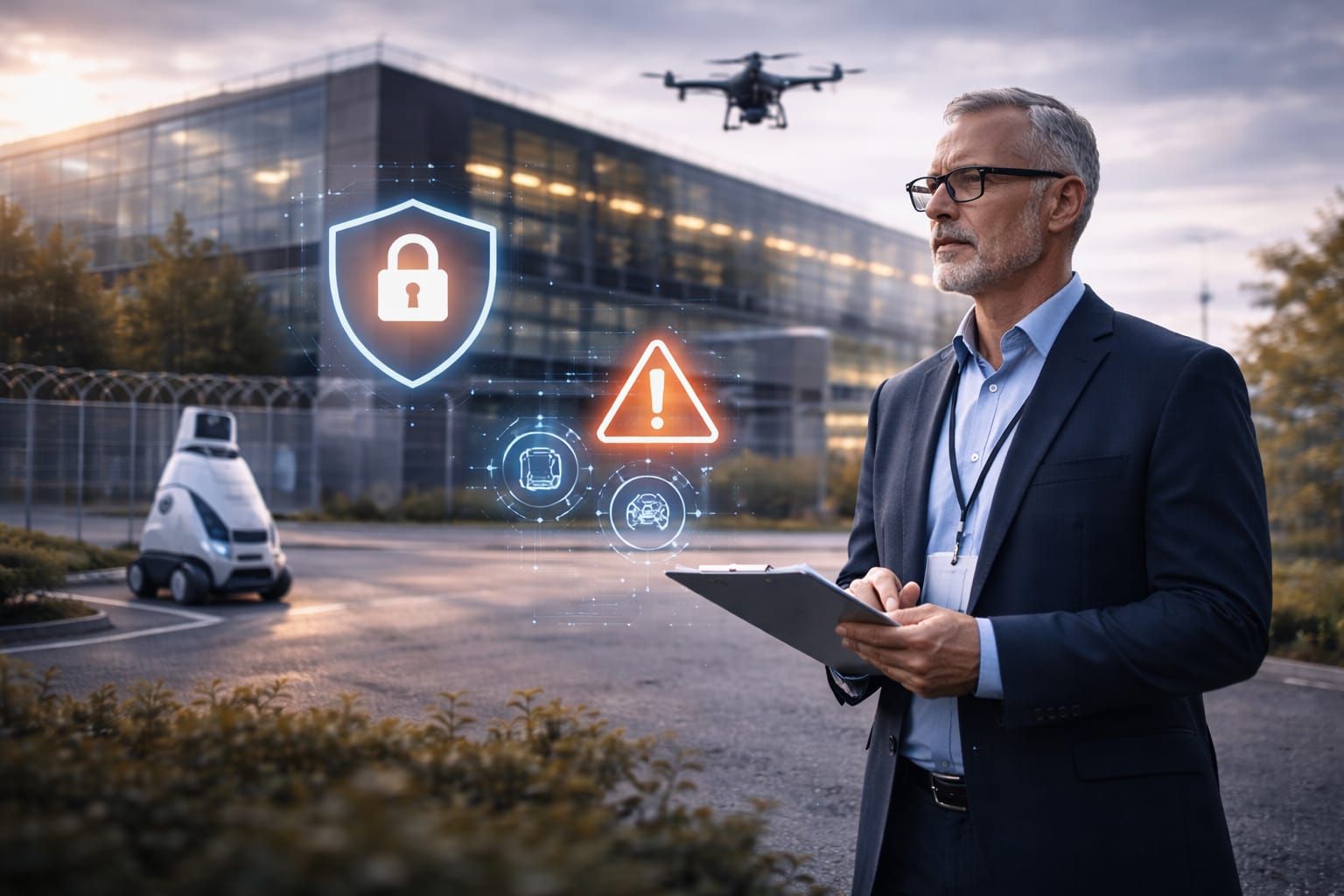
We help organizations stay ahead of evolving risks by identifying, evaluating, and integrating responses to emerging threats and advanced technologies. The threat landscape is no longer static, adversaries are leveraging new tools, targeting infrastructure in unconventional ways, and exploiting gaps created by rapidly deployed technologies. Our role is to provide clarity in this environment, helping clients understand what matters, what is actionable, and how to adapt security strategies without introducing unnecessary complexity or risk.
Our approach begins with continuous monitoring and analysis of emerging threat vectors, including drone-enabled reconnaissance and disruption, coordinated physical sabotage, insider-enabled attacks, and the convergence of cyber and physical tactics targeting connected systems. At the same time, we assess the rapid expansion of technologies such as AI-driven video analytics, edge-based IoT devices, cloud-connected security platforms, and automated response systems. We evaluate both the opportunity and the risk, ensuring that new capabilities enhance security outcomes without creating new vulnerabilities or operational dependencies.
Lock Risk differentiates itself by grounding innovation in engineering discipline and operational reality. We work with clients to validate advanced technologies through structured testing, pilot programs, and integration planning, ensuring compatibility with existing infrastructure, network environments, and governance requirements. This includes assessing cybersecurity implications of IP-based devices, validating analytics performance in real-world conditions, and ensuring that automation and AI outputs align with operational workflows and decision-making processes. Our experience in mission-critical environments ensures that innovation is introduced in a controlled, measurable way that supports reliability and resilience.
We also help organizations incorporate emerging threats and technologies into their broader security strategy and lifecycle planning. This includes updating threat models, refining design standards, and aligning procurement and specification processes to account for new capabilities. We support the development of policies and governance frameworks that address issues such as data integrity, system interoperability, and the long-term sustainability of deployed technologies. The goal is to ensure that organizations are not reacting to change, but proactively shaping their security posture to meet it.
From evaluating next-generation security technologies to preparing for evolving threat scenarios, Lock Risk provides a forward-looking, pragmatic approach to Emerging Threats and Advanced Technologies. The result is a security program that is not only current, but future-ready, capable of adapting to innovation while maintaining the stability, control, and resilience required in today’s high-risk environments.